Visual Automations
Put your routineson a schedule
A workflow is a routine Plexon follows. Describe the job, such as checking your inbox for invoices every morning, and choose when it starts. Review the steps, connect the apps it needs, and turn it on.
What happens in this clip
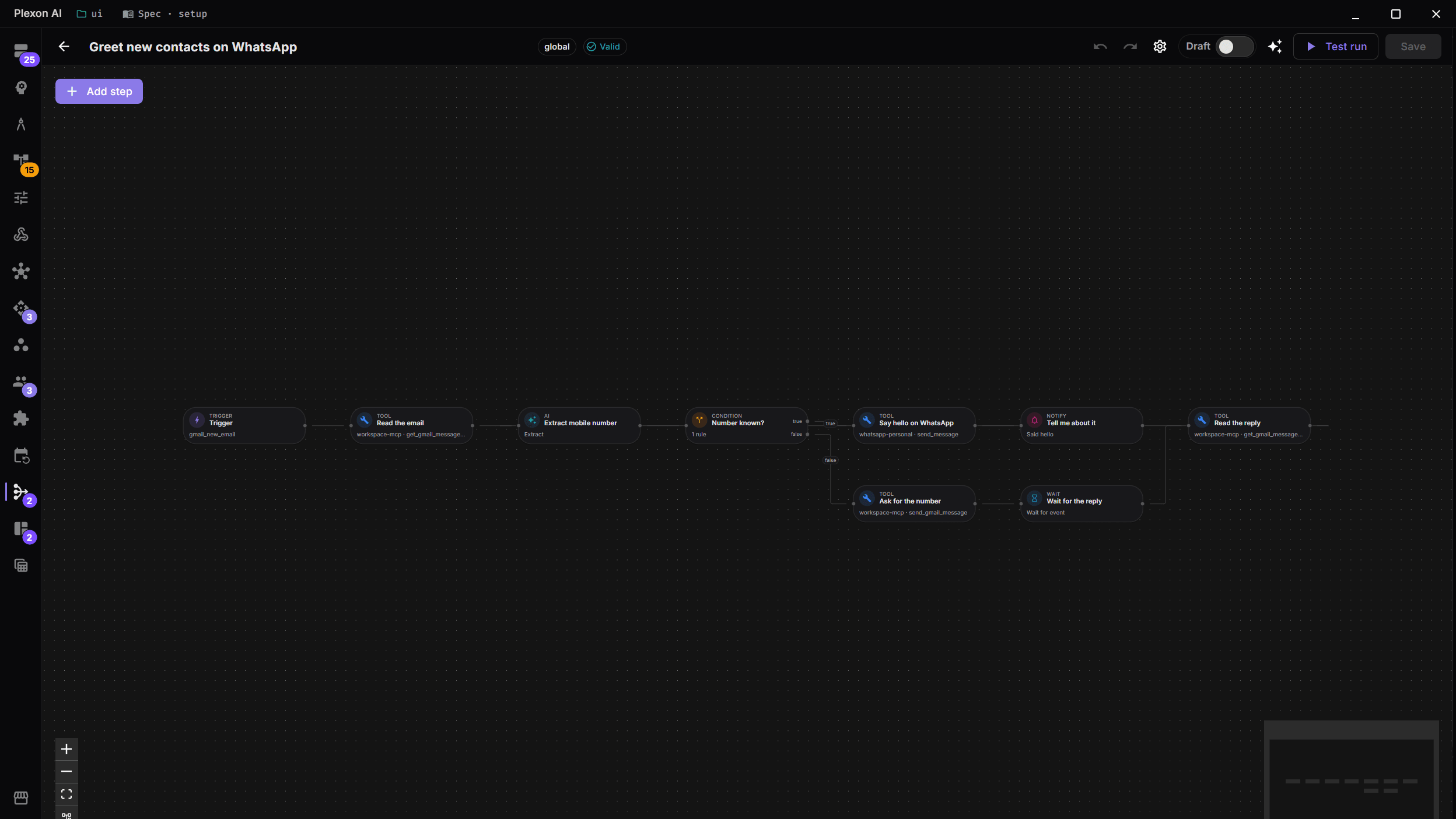
- A bundled workflow opens in the editor.
- The trigger at the top polls the inbox.
- A tool step reads the email, spending no AI tokens.
- An AI step pulls out named fields, and a branch decides what happens next.
- A message step sends the reply, and a notification step tells you it went.
Related features
Or just ask
Start with something you do every week
Tell Plexon what should happen and when. It drafts the routine for you to review before anything runs.
Say this
Every weekday at nine, check my inbox for anything mentioning an invoice and send me one message with the list.
You get back
A weekday routine that checks your inbox and sends you the list. Review the steps before turning it on.
Say this
When a new order comes in, thank the customer, and tell me if they asked for anything unusual.
You get back
A routine that replies to the customer, reads their request, and alerts you if it needs your attention.
Say this
Once a week, pull my numbers together and put them somewhere I can see them.
You get back
A weekly routine that gathers your figures and updates a dashboard, a board of charts and tables you can check at a glance.
Say this
Watch that folder, and when a new file lands, rename it properly and tell me.
You get back
A routine that watches the folder, renames new files, and sends a notification that opens the file. It starts only after you turn it on.
Every draft opens for you to read before it does anything. Nothing runs, sends, or refreshes until you have looked at it and said so.
Start with a routine you already do
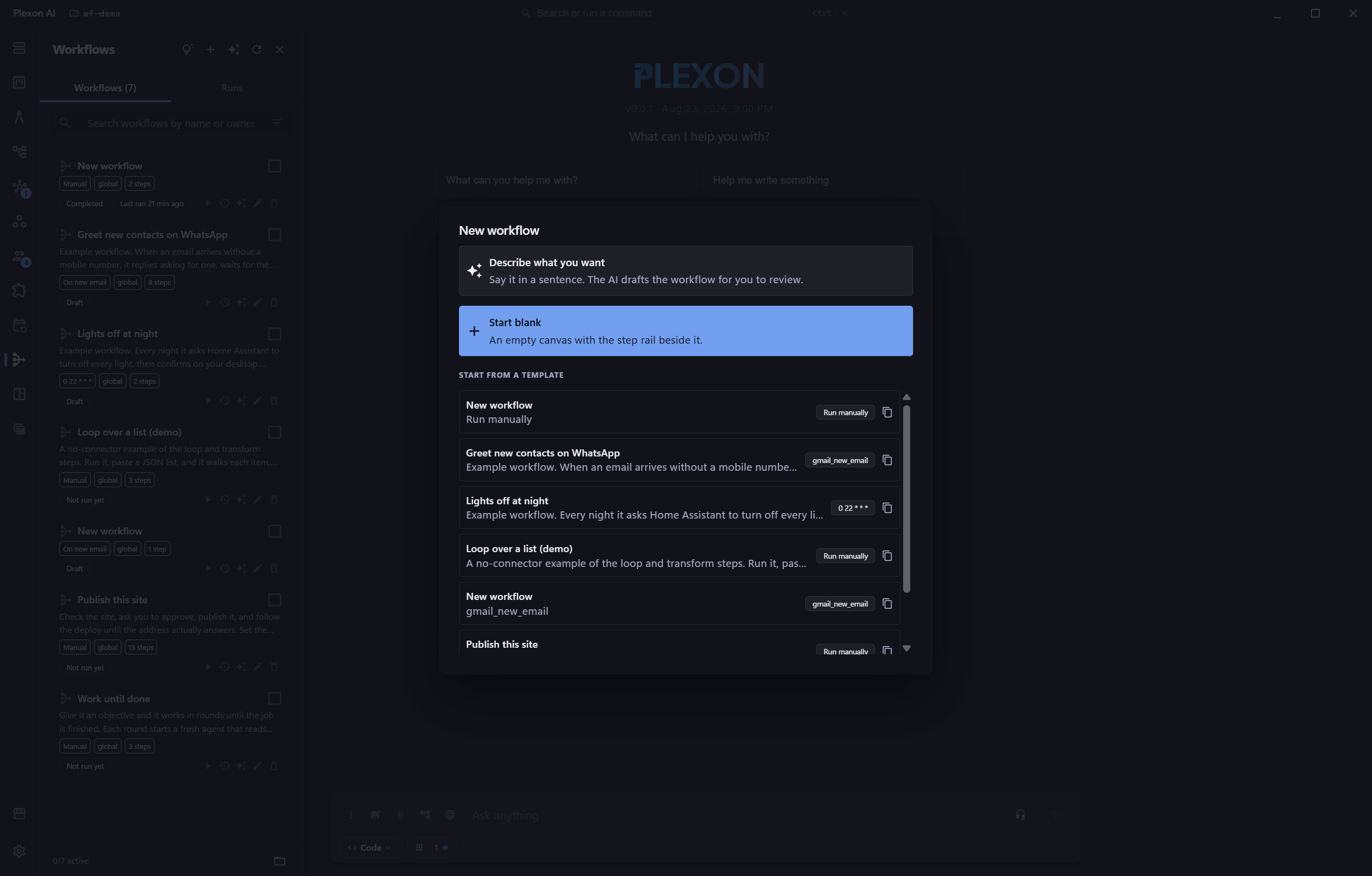
Open Workflows, choose New workflow, and describe the job. Plexon drafts the steps for you to review. You can also copy an existing routine or build one by dragging steps into place.
- Add familiar actions such as Send an email, Create a Jira ticket, or Send a Slack message
- Click a step to choose its app, fill in the details, or write an AI instruction
- Read the whole routine before turning it on; AI drafts arrive switched off
- Keep a routine in one project or make it available across your projects
Nine ways to start a routine
Choose when the first step should run. A trigger is the time or event that starts it.
- A schedule: every morning, each Monday, or at the interval you choose
- A new item in an app, such as a Jira ticket, Asana task, or HubSpot contact
- A regular check of an app for new items, such as Gmail messages
- A new article in a news feed
- A Telegram or WhatsApp message that matches your filter
- New activity on a GitHub project you already watch in Plexon
- A signal sent by another app
- Something happening in Plexon, such as a finished reply
- The Run now button, with any details you need to enter first
Choose what happens next
A routine can act in your apps, ask AI to read or write something, and decide which step comes next. Use AI only for the steps that need it. Sending a message or moving a file can run directly.
- Pull an invoice number from an email, draft a reply, or summarize a report
- Give a step to an agent, a specialist assistant, or a persona, a saved role with its own instructions and tools
- Repeat an action for each item in a list, such as every row in a spreadsheet
- Choose between steps based on a condition, such as whether an email includes a phone number
- Have a separate judge read the evidence before a routine accepts that a piece of work is finished
- Wait for a reply, pause for your approval, or send a notification to your desktop, Telegram, Slack or WhatsApp
- Answer a delivered report: reply to the notification on Telegram or Slack, or click it on the desktop, and a chat opens that starts from that report
- Open one of your own chats and send it the finished work, in Plan mode when you want a plan rather than edits
- Build a table, calculate totals, or tidy names and phone numbers without asking AI
Check the details before it runs
Each step has a form with named fields and examples. Choose information from an earlier step, such as the address found in an email. Test step shows what a step would do with sample data; a test send previews the message without sending it.
- Browse for a file or folder using the usual picker on your computer
- See matching files as you fill in a search
- Use the information menu to pick a result from an earlier step
- Errors appear beside the field that needs attention, with a suggested fix when available
- Review the next scheduled runs before you save
Keep track of customer follow-ups
An outreach routine can remember who it contacted, which channel it used, and what was said. Replies can continue the same conversation across email and WhatsApp. Open that conversation in the sidebar when you want to take over.
- Find contacts by status and read their message history
- Continue a previous exchange instead of starting a new conversation
- Automation pauses when you take over and waits until you resume it
- Contact records are saved on your computer; sending messages uses the connected service
Follow the work as it happens
Open the Runs tab to see each routine and its recent runs. Expand one to read what every step received, what it produced, how long it took, and what it cost.
- See the last 24 hours, the last 7 days, or the full history
- Runs waiting for your approval stay easy to find
- Clear finished runs individually, by routine, or once they are 7 or 30 days old
- A running job must be cancelled before you can delete it
Work through a long task in stages
Plexon includes a routine for jobs too large for one answer. Give it an objective and a limit on how many rounds it can run. Each round reads the previous work, tackles the next part, and reports what changed.
- Set the round limit and spending budget before it starts
- Read each round, stop the job, or follow its progress in Workflows
- The routine stops when the work is complete, it needs help, or it reaches your limit
Change a routine in your own words
Open the AI panel beside the steps and describe the change: “Send this on Friday instead” or “Ask me before replying.” The diagram updates as Plexon edits. You can also change any step yourself.
- Edit the whole routine or a single step
- Use Ctrl+Z to undo a change, then Save to keep the undo
- Stop cancels an AI edit in progress
- Editing an active routine leaves it switched on; a run already underway keeps its original steps
Reuse a routine with your team
Include a workflow in a persona or share it through a marketplace, a collection of tools and instructions people can install. Your teammates can use the same starting point and adjust it to their work.
- Include routines with the saved role that uses them
- Share through a marketplace you or your team manage
- Choose which projects can use an installed routine
Try the included WhatsApp greeting routine
Greet new contacts on WhatsApp, included with Plexon.
Plexon ships one example so a real workflow is there to read end to end. It watches Gmail for a new email, reads the message, and asks the AI to pull out a mobile number. If there is no number, it replies in the thread to ask for one and waits for the answer. Once it has a number, it sends a hello over WhatsApp and posts a note to your inbox.
It arrives switched off. Connect Gmail and WhatsApp, sign in to Google, and review each step. When you turn it on, it sends greetings automatically. Choose supervised mode first if you want to approve each WhatsApp message yourself.
The flow, step by step
- 1A new email arrives in Gmail
- 2Read the message body
- 3AI extracts a mobile number
- 4No number? Reply in the thread and wait for the answer
- 5Send a hello over WhatsApp
- 6Post a note to your inbox
What you need first
- The Gmail / Google Workspace connector, signed in once
- WhatsApp, paired by QR scan
- A review of every step
- The enable switch, when you are ready
This routine starts when a new email arrives. Turn it on when you are ready to watch for messages. Other routines can start from Run now and ask for any details they need first.
Market updates included with Stock Trader
Install the persona to add these routines, then choose which to turn on.
The Stock Trader persona includes routines that use free market data and need no extra sign-in. Choose the updates you want and set the times that suit you. Alerts send a message only when their conditions are met.
What ships
- Pre-market briefing: indices, sectors, FX, and headlines before the open
- Watchlist signal scan: RSI extremes, big moves, and moving-average crosses across your list
- Volatility radar: a heads-up when the VIX climbs
- Earnings and catalyst scan: the material news on your watch list
- Weekly sector rotation digest: which sectors lead and which lag
- Weekend crypto watch: a heads-up when a major coin makes a big move on a Saturday or Sunday
- End-of-day journal: a recap plus a prompt to log the day, saved to a file
- Single-symbol alert: an overbought or oversold read, a big move, or a 50/200-day cross
- Watchlist sentiment scan: flags extreme bullish or bearish crowd sentiment on your list
- This week's earnings: a dated digest of which watch-list names report in the next seven days
How they behave
- Quiet until it matters: a check that finds nothing notable sends nothing
- Free market data that needs no extra sign-in, with calculations on your computer
- They arrive switched off; review each routine and turn on the ones you want
- Edit the symbols and times, or attach the set to your own persona
Educational, not financial advice. The persona is read-only and never places orders.
Runs you can trust
A record of each run
A run keeps the steps it started with, even if you edit or delete the routine while it is working.
An outage does not end the run
A step that loses its connection waits for it to come back, for up to about fifty minutes, and carries on. A run that failed that way does not count toward the three failures that switch a routine off.
Interrupted sends wait for you
If Plexon stops in the middle of a send, the run pauses and asks what to do. It does not resend the message on its own.
Control AI spending
After a restart, a run that was spending AI credits waits for you to resume it.
Choose when to approve
Let a routine run on its own, or turn on supervised mode to approve each send.
Saved on your computer
Your routines and their history are stored locally. Steps that use an online app or AI service send the information needed for that task.
Remember each follow-up
Keep contact details, message history, and status together. Open a conversation and take over whenever it needs a person.
Turn a report into a PDF
Have AI write the report, then save it as a PDF with headings, lists, and tables. The conversion runs on your computer without spending AI credits.
Connects to
Nothing here works alone. See the whole map for how the pieces fit together.
This one is taught in step 5 of 8: put the job on a clock.
What feeds it
App Connectors triggers this.
An inbound message or a poll on a connected app starts a run.
App Connectors runs inside this.
A Tool step calls a connector directly, spending zero AI tokens.
API Connections runs inside this.
A Tool step calls any endpoint you imported.
Data Sources feeds this.
Give a workflow a Data source input and the loop step walks its rows.
AI Chat & Modes triggers this.
A finished reply or a tool call is an event a flow can watch for, matched on a phrase you choose.
AI Chat & Modes authors this.
Describe a flow in chat and the AI drafts it; it lands switched off, with a review link.
192 AI Agents runs inside this.
An Agent step hands one step to a headless sub-agent.
Decision Tools runs inside this.
Both the optimiser and the forecaster are bindable in a Tool step.
Richer Hook Events triggers this.
A hook can pick a workflow as its action, borrowing the hook's matchers.
Fast Decisions with Jev runs inside this.
A Decide step branches on a yes-or-no or pick-one answer, and the Judge step tries the cheap decision before spending a full model turn.
Personas runs inside this.
A Persona step runs a whole persona, with its skills and connected tools.
Where it goes
This renders into Dashboards.
A widget bound to a workflow shows the output of its most recent run, so opening the board does not re-run anything.
This renders into Flows.
Repeating an action across many things shows as a counted card you can pause.
This renders into Telegram Bot.
A workflow can ping you where you already are.
This renders into Slack Bot.
A workflow can post to a channel.
This is packaged by Personas.
Attach a workflow to a persona and it arrives ready to review and enable.
This is distributed by Unified Marketplace.
Flows travel inside a linked, managed or protected marketplace bundle.
This is packaged by Move to Another Machine.
Workflows and dashboards travel with your setup.
This triggers Publish Sites.
A workflow can rebuild a site and publish it on a schedule, pausing for your approval first.
This feeds Action Record & Tool Rules.
Every tool a workflow step runs lands in the record with the workflow named as the one that started it.