Planning & Forecasting
Work It Out,Do Not Guess It
A route through fourteen stops, a week of shifts, a budget split, a runway: these are searches and sums, not things to recall. An assistant that writes one from intuition produces an answer you cannot tell apart from a correct one. Plexon computes them, tells you the seed that reproduces the result, and names the constraint when nothing fits.
Related features
Ask for the Arrangement
Four kinds of question, all of them searches rather than recall: the order to visit stops in, what fits in which container, who does what and when, and how to split a budget. An assistant answering these from intuition produces something shaped like an answer, and you cannot tell by reading it. Plexon runs the search.
- "Best order for these nine stops, back to the depot"
- "Fit these pallets into two vans"
- "Six jobs, three technicians, job 4 waits on job 1"
- "2000 kcal at 40/30/30 from this list, under 25 euro"
It Says When Nothing Fits
An impossible request gets a reason, not a shrug. Plexon names the limit that blocked it and the amount it was missed by, so you know which number to change. "No solution" tells you nothing; "the 1800 kcal ceiling and the 150 g protein floor cannot both hold with this food list" tells you what to do next.
- The blocking constraint is named, with the gap
- An item too big for every container is caught before the search
- A dependency loop in a schedule is refused, with the loop shown
- Nothing is quietly dropped to make the answer come out
Forecasts Come Back as a Range
How long the money lasts, whether the van makes its slot, how far a portfolio could fall, how long people sit in the waiting room. Each of those has a spread, and a single number hides it. Plexon runs the scenario thousands of times and answers with the odds of the thing you actually care about.
- "What are the odds we run out before the round closes?"
- "How likely are we to be late on a four hour promise?"
- "Three rooms, seven patients an hour, how long is the wait?"
- Describe the uncertainty as worst, likely, and best case
The Spread Is the Point
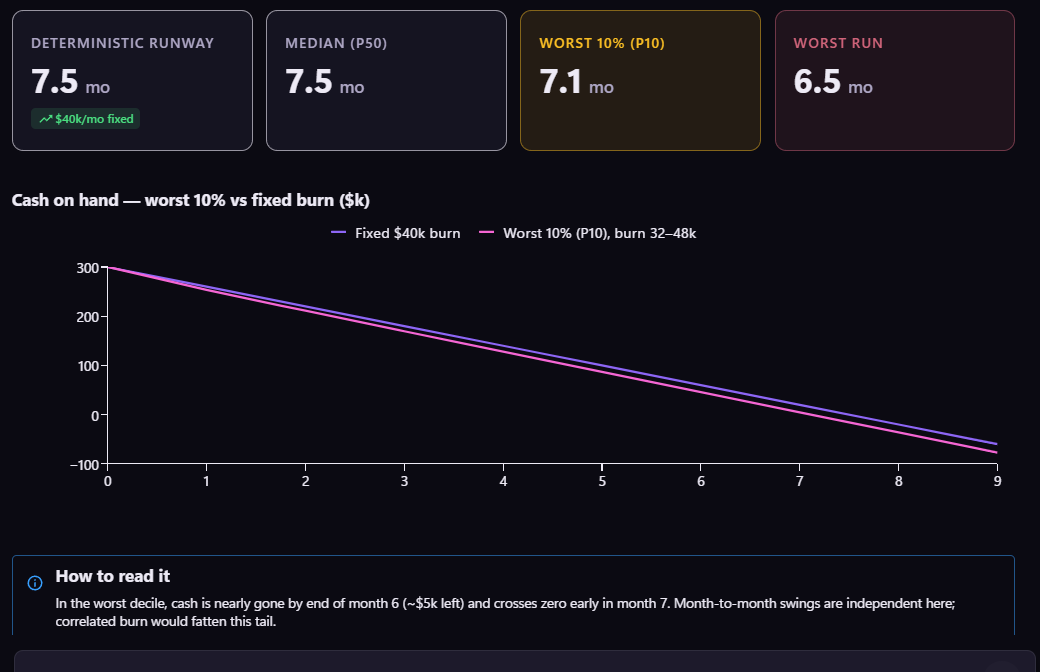
Ask how long 300k lasts at 40k a month and arithmetic says 7.5 months. That number is only true if the burn never moves. Let it swing 8k either way and the picture that comes back is a band, not a line: the median barely shifts, the worst decile runs dry two weeks early, and the single worst run of ten thousand dies a month sooner. Reading those four numbers side by side is the whole point, because the one you plan against is rarely the average.
- The deterministic answer is kept for comparison with the spread
- Median, worst decile, and worst observed run, together
- A "how to read it" note under every chart, in plain language
- It says out loud when the model assumed swings are independent
The Same Answer Tomorrow
Every result carries the seed that produced it. Hand a driver a route on Monday and you can reproduce exactly that route on Friday, which matters when someone asks why this order and not another. Nothing here is a black box that answers differently each time you ask.
- One seed reproduces the run exactly
- The objective value is reported, so two runs compare
- It says when it ran out of search budget rather than pretending
- It never calls a result optimal unless it can be sure
Where It Shows Up
These work in ordinary chat, and they also bind into boards and scheduled work. The Founder Cockpit carries a cash chart built on the runway model, and the monthly runway alert now sends a worst case alongside the average. A workflow can re-plan a delivery round on a timer without spending a token, because no model is involved in the arithmetic.
- Built in on every install, whichever role you work in
- Bindable in dashboard widgets and workflow steps
- No API key, no network call, no per-run cost
- Distances come from a maps service or from you, never invented
What It Covers
Routes
Visit order across stops, with time windows and an optional return leg. Give it real distances and it gives you the shortest run it can find.
Packing
Items into containers by weight and volume, using as few as possible. Containers can be different sizes, because real fleets are.
Scheduling
Tasks across however many people or machines you have, respecting what must finish before what, to end as early as possible.
Allocation
Whole units under a budget, with a floor and a ceiling per item. Hit a target, or get the most value the money buys.
Odds, Not Averages
The probability of the outcome that matters: running out of cash before a month you name, missing a promised time, breaching a wait.
Reproducible
Every answer carries its seed. Run it again and get the same route, the same roster, the same bands.
Honest About Its Limits
Each forecast states what it simplified. The waiting room model assumes nobody walks out, and it says so rather than letting you read more into the number.
Runs on Your Machine
No key, no upload, no per-run cost. The numbers you type stay where you typed them.
Connects to
Nothing here works alone. See the whole map for how the pieces fit together.
Where it goes
This feeds Dashboards.
Bindable, so a board can carry a cash fan chart built on the runway model.
This runs inside Dynamic Workflows.
Both the optimiser and the forecaster are bindable in a Tool step.