New · September 2026
Fast decisionswith Jev
Most of what an assistant does is not writing. It is deciding: which control to click next, whether a step passed, which of forty files matter, whether this is a good moment to interrupt you. Plexon sends those questions to Jev, a decision model from TypeSafe that answers with a probability in well under a second and never writes a word. It is included on Pro and Premium.
Related features
A Model That Answers, Not Writes
Jev takes a state (a page outline, a ticket, a workflow result) and named questions of three kinds. A yes-or-no question comes back as a probability. A pick-one question comes back as the option chosen and a probability for every option. A rate-it question comes back as a position on a scale you define. Several questions about the same state ride one call, so asking more costs no extra wait. It never produces a sentence, so it cannot be talked into one.
- Three question kinds: yes or no, pick one of up to 255 options, rate on a scale of up to 10 levels
- Every answer carries its probability, and Plexon acts only above a bar set per use
- Released by TypeSafe on 15 September 2026; Plexon pins one version and re-tunes when it moves
- Our own open-source Go client, jev, is what Plexon calls it with
Where Plexon Uses It
Anywhere a full chat turn was too slow or too expensive for a small choice. The browser and desktop loops are the visible ones: give the page one whole goal and Jev picks each next control from the outline. The rest happen behind the chat, and each falls back to what Plexon did before the moment Jev is unavailable, so nothing waits on it.
- Browser steps and page collection: which control next, and whether a feed has been read to the end
- Desktop steps: the same loop over a window in Desktop Automation
- Plexonaki: whether this is a good moment to speak, and what is on your screen when you ask
- Answers as cards and tables: repairing a mismatch and drawing a placeholder while the real one loads
- Workflows: a Decide step, and a cheap first pass for the Judge step
- Long chats: dropping unrelated tool results before a condense, kept text stays word for word
- Code review: the riskiest change first in the review queue, and in automatic review
- Choosing a specialist, walking your memory, shortlisting files, and an optional check before a risky command
- With Auto Routing on: how hard the request is, which model family, and how deep to think
Included on Pro and Premium
There is nothing to sign up for and nothing to pay on top. The decisions come with your plan: 1,500 every 5 hours on Pro, 4,000 every 5 hours on Premium, where they run on priority keys. Account usage shows the Decisions row beside messages and images.
- Pro: 1,500 decisions every 5 hours
- Premium: 4,000 decisions every 5 hours, on priority keys
- No TypeSafe account and no key of your own
- The allowance counts calls, not questions, so batching questions is free
How the Key Reaches Your Computer
Your computer calls TypeSafe directly, so a decision does not go through our server and wait there. The key that lets it do that is handed over encrypted under a key made for your account, lives in memory for ten minutes, and is forgotten. It is never written to a file, never put in a setting, and never shown. Signing out forgets it at once.
- A lease of ten minutes, then a fresh one, with the old key wiped
- Sealed on the server under a master key that never leaves it
- Usage is reported back per lease, so the allowance is counted where the plan lives
- Our server keeps nothing about the decision itself
What Leaves Your Computer
Two uses send text from an app to TypeSafe: the browser loop sends the page outline, and the desktop loop sends the text of the one window you named. Never a screenshot, never a password field, and a value you asked it to type is masked before it goes. Nothing about a decision is logged, not on your computer and not on our server: the log holds the model name and a request id, and that is all.
- Page text and window text only, for the two loops, and only while they run
- A password field hands the page back to you instead of typing
- The pet reads your screen only with its own switch on, and only when you ask
- Nothing typed into a page is ever kept
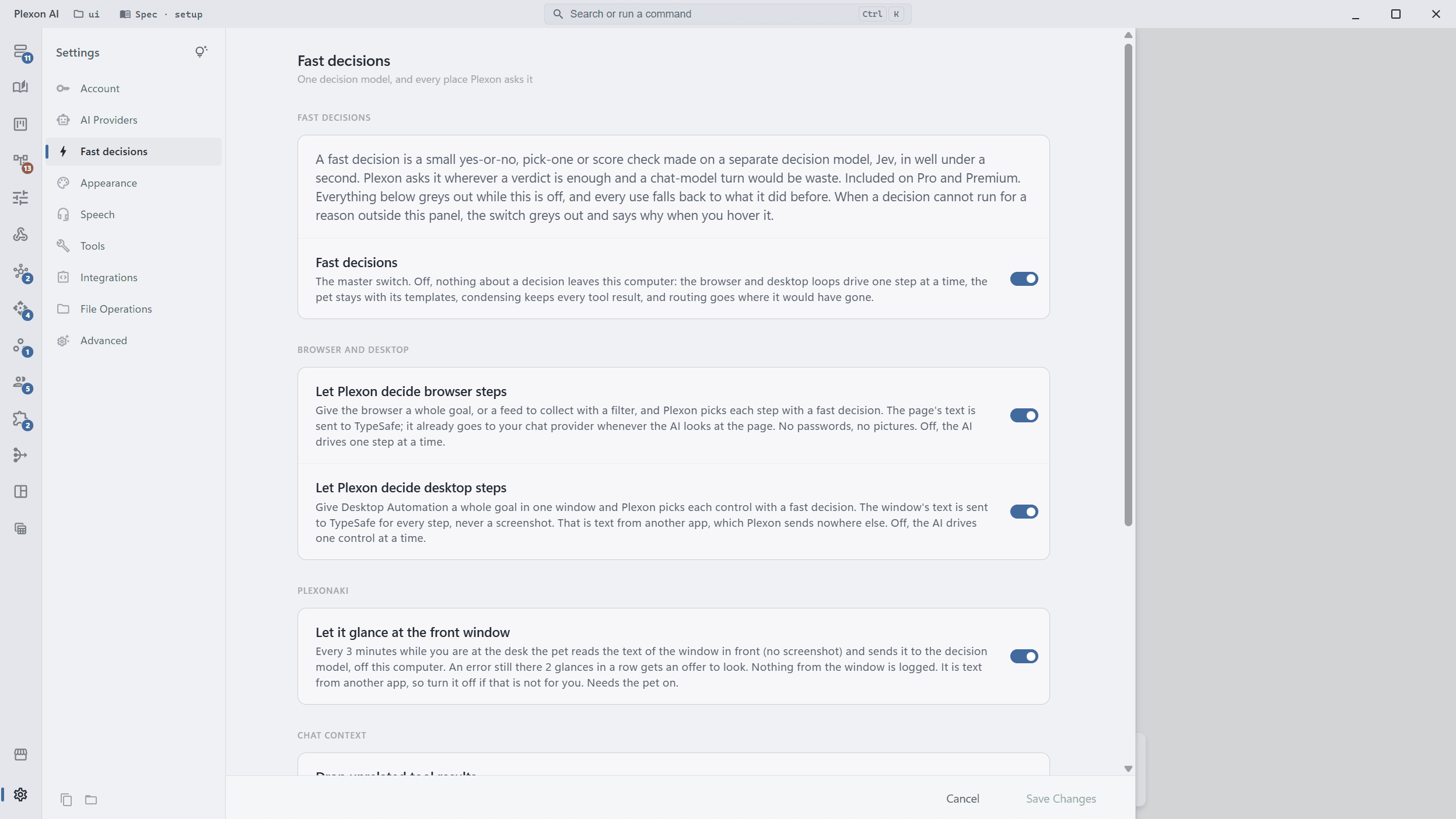
The Switches
Every switch is in one place, Settings, Fast decisions. The master switch at the top turns the whole thing off; when a decision cannot run for a reason outside the panel, that switch greys out and says why when you hover it. Below it, the browser loop, the desktop loop, the pet's glance, dropping tool results before a condense, the check before a risky command and Auto Routing each have their own switch, greyed while the master is off. The loops and the glance are on from the start; the risky-command check and Auto Routing are off until you turn them on.
- Off means every use falls back to what Plexon did before, at once
- The three loops that send another app's text each have their own switch
- A greyed-out master switch says why: signed out, not on your plan, allowance used, not reachable
- Turning it off spends nothing and reports what was used
Under the Hood
Under a Second
A decision comes back in a few hundred milliseconds. The loop that drives a page asks once per step instead of once per click.
Several Questions, One Call
Which control, is it a login wall, is the goal done, did the page change. All in one round trip, each with its own probability.
A Key You Never See
Leased to your computer encrypted, held for ten minutes, wiped. Never in a file, never in a setting, never logged.
Falls Back, Never Fails
When Jev is unavailable or unsure, every use takes the path it took before. A chat turn or a workflow run never fails because of it.
For developers
Plexon calls Jev through jev, our open-source Go client for the TypeSafe System One API, released on 21 September 2026. Typed answers, retries, client-side rate limits, and a skill file that teaches a coding assistant to use it correctly. The model and its API are documented at typesafe.ai. The two loops it drives are described on the Embedded Browser page and the Plexonaki page.
Connects to
Nothing here works alone. See the whole map for how the pieces fit together.
What feeds it
Plexon Provider feeds this.
The decision allowance comes with the plan: 1,500 every 5 hours on Pro, 4,000 on Premium, with the key leased to your computer for ten minutes at a time.
Where it goes
This feeds Embedded Browser.
Given one whole goal for a page, Jev picks each next control from the page outline, and says when the goal is done or a login wall is in the way.
This feeds Plexonaki.
The pet asks Jev whether this is a good moment to speak and, with its glance switch on, what is on your screen when you ask.
This feeds Dynamic UI Widgets.
A card or table that came back malformed is repaired by one pick-one question, and a placeholder is drawn while the real one loads.
This runs inside Dynamic Workflows.
A Decide step branches on a yes-or-no or pick-one answer, and the Judge step tries the cheap decision before spending a full model turn.
This feeds Diff Review Queue.
Each finished change is rated for risk, and the queue lists the riskiest first.